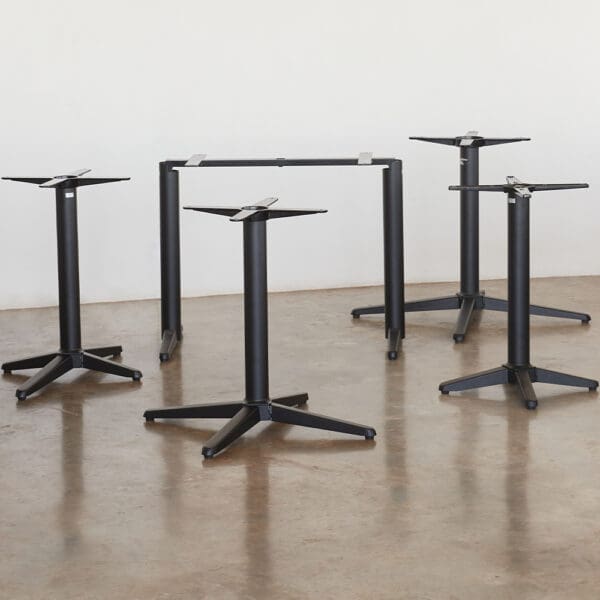
In this course, we’re going to walk through Oak Street Manufacturing’s indoor restaurant table base lineup and, more importantly, how to confidently match the right base to the right application. We’ll start by reviewing the two main categories: Black Table Bases and Community Table Bases. From there, we’ll explore how each style is constructed, what makes them perform well in commercial environments, and when each option makes the most sense for a customer’s project.
Oak Street Indoor Restaurant Table Bases
-
Black Table Bases
• Stamped Steel Table Bases
• NOROCK Self-Stabilizing Table Bases
• Adjustable Table Bases
• Folding Table Bases -
Community Table Bases
• Harvest Community Bases (for large harvest-style tables)
• Quick-Ship Community Bases (standardized, fast delivery)
In the course you would discuss:
-
Design and construction fundamentals: materials, welding and stamping processes, finishes, and tolerances.
-
Functional characteristics and best use cases: stability, load capacity, height options (standard, bar, ADA), adjustability, and folding/portability.
-
Installation and specification guidance: how bases pair with tabletops, recommended configurations by tabletop size, leveling considerations, and ADA compliance.
-
Ordering and logistics: lead-time differences between custom vs. Quick Ship bases, packaging (knockdown shipping), and on-site assembly processes.
-
Comparative field performance: lifetime durability, ease of service and maintenance in commercial settings.
Benefits of Oak Street Table Bases vs. Typical Competition
1. Material and Structural Advantages
-
Stamped Steel Construction: Oak Street bases use stamped steel rather than cast iron. Stamped steel parts resist fracturing under heavier loads and deliver tighter dimensional tolerances.
-
Welded Structural Components: The column, spider (top support plate), and anchor plate are welded for rigidity; this results in greater overall stability than many competitive bases assembled with rods and loose fasteners.
-
Larger Spiders for Support: Oak Street’s spider components are larger than many competitors’, improving load distribution and stability for everyday heavy use.
2. Assembly and Field Serviceability
-
Simplified Two-Piece Assembly: Oak Street’s bases typically assemble with fewer components—tube/spider and base—reducing install time on site.
-
Improved Fastening System: A short bolt into a welded anchor plate minimizes loosening over time, unlike competitor designs that rely on long threaded rods that can torque/stretch and become unstable.
-
Adjustable, Non-Marring Levelers: Standard on many models, these glides help achieve level tables on uneven floors and protect flooring surfaces.
3. Durability and Lifecycle Value
-
Resistance to Fracture and Wear: Unlike cast iron, stamped steel does not crack under impact or repeated load; this improves longevity in high-turnover environments.
-
Better Glide Tab Integration: Welded glide tabs with hollow backs (possible with steel) reduce the risk of damaged tabs—a common issue with cast bases.
-
Design Adaptability: Oak Street offers adjustable and self-stabilizing (NOROCK) designs that maintain performance across variable floor conditions, reducing wobble complaints.
4. Commercial Fit and Logistics
-
Quick Ship Options: Community bases and selected configurations are offered with expedited delivery, supporting tight project schedules.
-
Industry-Focused Design: Oak Street products are engineered specifically for restaurant and hospitality use, balanced for durability, serviceability, and aesthetic versatility in commercial interiors.
In summary: Your Oak Street course would not only cover technical product knowledge and application criteria but also enable attendees to clearly articulate the competitive advantages of these bases—strength, assembly efficiency, long-term performance, and commercial suitability—compared to standard cast iron or lower-grade alternatives that dominate much of the market.
Curriculum
- 2 Sections
- 6 Lessons
- Lifetime
Instructor