

Cheap furniture is expensive. Period.
Executives reviewing capital expenditures or facility budgets often fixate on the upfront invoice price. A chair costing $120 appears far more attractive than one at $220—until replacement cycles, maintenance downtime, lost productivity, guest dissatisfaction, and safety liabilities enter the equation. Over a five-year horizon, the “cheaper” option frequently doubles or triples in total cost of ownership (TCO).
This executive overview examines why commercial-grade (or contract-grade) furniture delivers superior long-term ROI across hospitality, offices, healthcare, education, and other high-traffic environments. We explore failure modes of residential-grade pieces, lifecycle costing, industry benchmarks, and the specific manufacturing advantages that set premium suppliers apart. Data, case examples, and visual analyses demonstrate that investing in durability is not an expense—it is strategic asset management.
The False Economy of Residential-Grade Furniture in Commercial Settings
Residential furniture is engineered for light, intermittent use in controlled home environments—perhaps a few hours daily by family members. Commercial environments subject pieces to constant stress: hundreds of daily users, aggressive cleaning regimens, spills, stacking, shifting layouts, and occasional abuse.
Key failure mechanisms include:
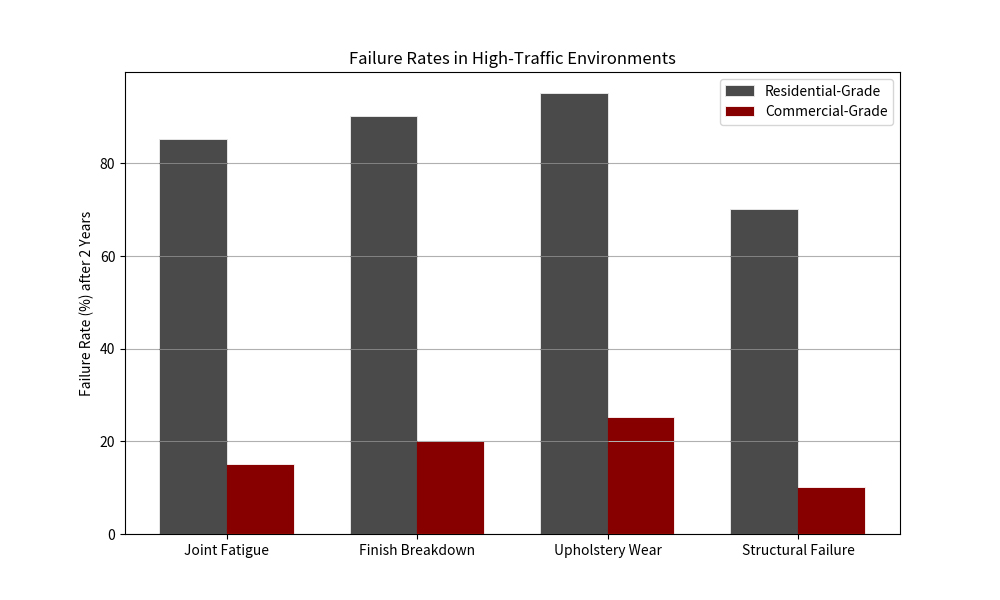
- Joint Fatigue: Screwed or glued joints in residential pieces loosen under repeated loading. In restaurants or lobbies, a single chair may see 50–200+ uses per day. Over months, this leads to wobbling, collapse risks, and liability.
- Finish Breakdown: Residential laminates, paints, and stains degrade quickly under commercial cleaners, UV exposure (near windows), and abrasion. Tables and chairs lose their professional appearance within 12–24 months.
- Upholstery Wear: Fabrics rated for 3,000–9,000 double rubs (a standard abrasion test) fail rapidly in high-traffic venues. Commercial upholstery often exceeds 15,000–100,000+ double rubs, with stain-resistant treatments and reinforced construction.
Failure rate comparison in high-traffic environments (estimated after 2 years of commercial use):

The Core Metric: Cost per Year of Useful Life
Savvy leaders evaluate furniture through Cost per Year (CPY) or Total Cost of Ownership rather than sticker price.
Simple CPY Formula: CPY = (Purchase Price + Installation + Maintenance + Replacement Disruptions) / Expected Useful Years
Real-World Example (one chair, conservative assumptions):
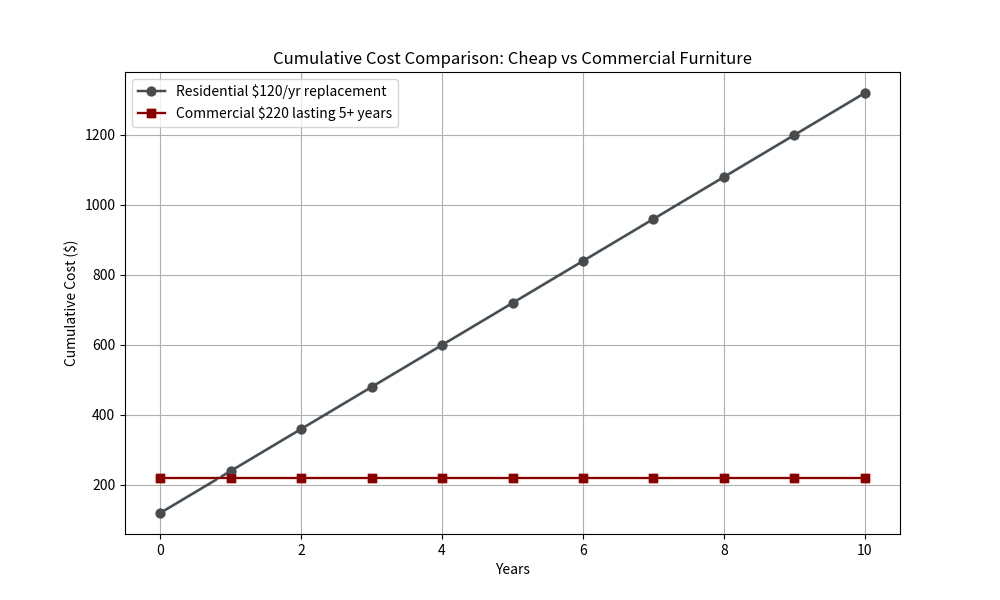
- Option A (Residential-grade): $120 initial cost. Lasts ~1–2 years in a busy restaurant or office waiting area before becoming unsightly or unsafe. Annual maintenance/repairs add ~$20–30. Replacement labor and downtime add hidden costs.
- Option B (Commercial-grade): $220 initial cost. Lasts 5–10+ years with minimal maintenance. Stronger warranties (often 5–15 years structural) reduce risk.
Cumulative Cost Over 10 Years (for 100 chairs):

Additional hidden costs of cheap furniture:
- Operational Downtime: Removing broken chairs reduces seating capacity, directly impacting revenue in restaurants or service environments.
- Guest/Employee Experience: Worn or unstable furniture signals poor quality, harming brand reputation and employee morale/productivity.
- Compliance and Safety Risks: Commercial settings often require adherence to standards like BIFMA, ASTM, or industry-specific fire codes. Residential pieces frequently fall short.
- Waste and Sustainability: Frequent replacements increase landfill contributions and procurement overhead.
Industry Benchmarks and Market Context
Commercial furniture serves demanding sectors:
- Hospitality/Restaurants: High replacement frequency for seating (often 3–5 years for lower-tier items). Durable pieces extend cycles significantly.
- Healthcare and Education: Emphasis on cleanability, ergonomics, and extreme durability.
- Hotels: Major FF&E renovations every 7–10 years.
Market analyses consistently show that while commercial-grade pieces carry 2–3x higher upfront costs, they deliver lower TCO through extended service life and reduced maintenance.
Oak Street’s Manufacturing Differentiators: Engineered for Performance
Not all “commercial” furniture performs equally. Oak Street Manufacturing stands out through vertical integration and purpose-built capabilities tailored to high-traffic demands.
1. Advanced Metal Fabrication and Welding Capabilities Robust frames use precision welding and reinforced construction that resist joint fatigue far better than screw-assembled residential alternatives. This structural integrity is critical for stacking stools, banquet chairs, and tables enduring daily repositioning.
2. Commercial-Grade Finishes and Upholstery Specialized coatings resist chemicals, abrasion, and fading. Upholstery selections prioritize high double-rub ratings, antimicrobial options, and ease of cleaning—essential for restaurants, healthcare, and public spaces.
3. Built Specifically for High-Traffic Environments Products are tested and warranted for real-world commercial abuse. This includes quick-ship options for tables and custom manufacturing, minimizing project delays while ensuring longevity.
These differentiators translate directly to ROI: fewer replacements, consistent aesthetics over years, lower total spend, and stronger warranties that protect your investment.
Broader Strategic Benefits Beyond Pure Cost Savings
Brand and Customer Experience Premium furniture enhances perceived value. Guests in restaurants or hotels notice quality seating and tables, correlating with higher satisfaction scores and repeat business.
Employee Productivity and Well-Being In offices, ergonomic, durable desks and chairs reduce discomfort and absenteeism. Stable, professional environments support focus and collaboration.
Sustainability and ESG Considerations Longer-lasting products reduce material consumption and waste. Many commercial manufacturers, including those emphasizing American-made production, align with corporate sustainability goals.
Flexibility and Future-Proofing Commercial lines often offer modular designs, replacement parts, and customization, allowing updates without full replacements.
Risk Mitigation Extended warranties and compliance reduce legal and insurance exposures from failures.
Case Studies and Quantified Outcomes
Consider a mid-sized restaurant chain replacing seating every 18 months with budget options. Switching to commercial-grade extended cycles to 6–8 years, cutting furniture-related CapEx by over 50% over a decade while improving guest reviews.
Healthcare facilities using contract-grade furnishings note reduced infection control issues due to superior cleanability and fewer porous surfaces that harbor wear.
While exact figures vary by operation, the pattern is consistent: leaders who calculate lifecycle value outperform those focused solely on initial bids.
Implementation Best Practices for Executives
- Adopt Lifecycle Procurement Policies: Require TCO analysis in RFPs, including projected 5- and 10-year costs.
- Partner with Specialized Manufacturers: Work with suppliers like Oak Street that control fabrication for consistent quality.
- Specify Performance Standards: Demand double-rub ratings, weight capacities, warranty details, and testing certifications.
- Phase Investments Strategically: Prioritize high-traffic areas first for maximum immediate ROI.
- Budget for Total Ownership: Allocate based on CPY rather than first-cost savings.
- Monitor and Maintain: Even durable furniture benefits from scheduled inspections and professional cleaning.
Conclusion: Invest in Assets, Not Expenses
Furniture in commercial environments is not a consumable—it is a long-term operational asset directly influencing revenue, costs, safety, and brand equity. The hidden ROI of commercial-grade furniture emerges when executives shift perspective from invoice price to performance over time.
Oak Street’s focus on metal fabrication excellence, commercial-grade materials, and high-traffic engineering exemplifies the manufacturing discipline required to deliver this value. By choosing pieces built to endure, organizations reduce waste, control budgets more predictably, and create environments that support their operational and guest-experience goals for years to come.
Evaluate your next furniture procurement through the lens of lifecycle value, not just upfront cost. Buy for performance and longevity—not the invoice price. Your balance sheet, customers, and facility teams will thank you for the strategic foresight.
This executive overview draws on industry benchmarks and manufacturer insights. For facility-specific TCO modeling or product recommendations tailored to your environment, consult experienced commercial furniture partners.